.jpg)

***

Photo: Barry Bergdoll/Image: Museum of Modern Art
***
Max Eternity - Today I had a phone conversation with Barry Bergdoll, the Chief Curator of Architecture at the Museum of Modern Art (MoMA). I have had brief encounters with Bergdoll before, but today our talk was more focused and uninterrupted. Bergdoll, who's also a professor at Columbia University, has been one of the more prolific figures to take an interest in the the preservation effort for Atlanta's Downtown Central Library, designed by Marcel Breuer.
Last year, in a Metropolis Magazine article written by Jonathan Lerner, Bergdoll, Jon Buono, Isabelle Hyman and John Szabo, discussed the future of Central. I was interviewed as well, and so was Commissioner Rob Pitts, who is promoting the demolition idea.
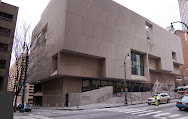
In January of this year, Bergdoll gave a talk at the library entitled "Marcel Breuer: The Invention of Heavy Lightness" where, using the Central Library and the Whitney Museum--both built by Breuer in a 15-year sequence--he spoke about Breuer's ability to create monumental spaces that seem to hover and float above ground--adjacent sidewalks and streets.
Bergdoll has been involved with numerous book projects, as writer and editor, and most recently he, along with another curator at MoMA, Leah Dickerman, recently completed an epic exhibition in celebration of last year's 90th Anniversary of the Bauhaus, entitled 1919-1933: Workshops for Modernity.
-click image to visit t MoMA online-

Interview: Barry Bergdoll
_________________________
Max Eternity (ME): Beyond functionality, what role does architecture play in the everyday experience?
Barry Bergdoll (BB): Firmness, commodity and delight. It's delight and beauty, and it's a sense of civic spirit--an ethos about things that matter in society.
ME: It hasn't happened since 1938, so what prompted MoMA to launch such a tremendous retrospective of the Bauhaus school this/last year? Is something especially relevant now?
BB: Well the nominal reason was the 90th anniversary of the Bauhaus and the 80th anniversary of the museum--MoMA--a museum inspired by the Bauhaus. Anniversaries are not important, because they happen. What was relevant, was to look back at different media, seeing how they influence each other--how media cross pollinates. Fixed and moving with still. how hybrids mix in. So it was, lets just look at avant garde art a century ago with different eyes.

-The Whitney Museum of American Art/Image: Wikipedia -
ME: Recently I heard you speak in Atlanta, the title of your talk was "Marcel Breuer: The Invention of Heavy Lightness." We know that Breuer was both a student and instructor at the Bauhaus, yet what of this heavy lightness, as you say?
BB: The Atlanta library is a perfect example, the Whitney as well. It's a kind of gravitas of monumental forms. It's holding them aloft in the air--this idea that a heavy object can be light, floating above the sidewalk--the street. People think of the Whitney as an inverted ziggurat. but it's a hollow, inverted ziggurat, because it's transparent on the ground floor level. It's not like a pyrimid or ziggurat, because it gets heavier as it rises.
What Breuer was doing in his late career was thinking of how [he could] I can go back to monumentality--the ancient large scale forms, not reproduce it, but create it in a modern way--the way that you create that with steel form and concrete structures. So Breuer creates a synthesis with primitive monumentality and modern structural lightness.

- The Atlanta-Fulton Central Public Library/Image: Wikipedia -
ME: Breuer built many houses. One I've recently discovered is the Weizenblatt house in North Carolina, but I read last year that you had taken an interest in the Frank House, located in Pennsylvania?
BB: Yes, that's the earliest American example where Gropius and Breuer were able to realize, in this country, the idea that a building was a total work of art. They did the building and the furniture, and had an impact on the landscape as well. Everything was a part of the total design concept.
ME: I understand one of your fields of study is the history of exhibiting architecture, and the museum challenges and practices associated with that. What's this about?
BB: That's simple. It's a simple problem, that you can't bring buildings inside a museum. So you have to figure out how to exhibit something that you can't put in a gallery. Unlike paintings and sculpture, where you bring things in to let people see, with architecture you have to try and create a relationship with a work of art of something that's not there.
ME: I recently saw a video interview with Richard Miers at the Big Think website. In that interview, Miers was asked if architecture was art. In response he said that all buildings weren't architecture, but that good architecture was art? Your thoughts on this, In other words, what defines a building as architecture--as art?
BB: That's a pretty wide open statement. To ask on a scale, where do you put the threshold--when do you say? I say yes, architecture is art.
BB: Yes, that's the earliest American example where Gropius and Breuer were able to realize, in this country, the idea that a building was a total work of art. They did the building and the furniture, and had an impact on the landscape as well. Everything was a part of the total design concept.
ME: I understand one of your fields of study is the history of exhibiting architecture, and the museum challenges and practices associated with that. What's this about?
BB: That's simple. It's a simple problem, that you can't bring buildings inside a museum. So you have to figure out how to exhibit something that you can't put in a gallery. Unlike paintings and sculpture, where you bring things in to let people see, with architecture you have to try and create a relationship with a work of art of something that's not there.
ME: I recently saw a video interview with Richard Miers at the Big Think website. In that interview, Miers was asked if architecture was art. In response he said that all buildings weren't architecture, but that good architecture was art? Your thoughts on this, In other words, what defines a building as architecture--as art?
BB: That's a pretty wide open statement. To ask on a scale, where do you put the threshold--when do you say? I say yes, architecture is art.

- MLK Central Library in Washington D.C. by Ludwig Mies Van Der Rohe/Image: Wikipedia -
ME: So many important buildings that have found themselves at risk of being demolished, are public structures, like for instance the Central Library in Atlanta and the Mies Van Der Rohe designed MLK Library in Washington DC. We know that architects and historians are interested in these sites, but what about the people they serve, who often times have no knowledge of a building's history? How might they be better informed?

- Breuer's Atlanta Library, 2012 (Image: Max Eternity) -
BB: I think one of the things that's mystifying is why children are not taught in school about architecture? Because of this, when a building is at risk, you end up with a small group of people fighting a battle that most people didn't even know about. Architecture concerns everybody. It's the art form that really influences the quality of our daily lives most directly. If our schools would take that on we'd have a much more engaged citizenry.
ME: Thanks for taking the time to speak with me
BB: Great. Nice talking with you again.


